Cost to Install Laminate Flooring on Stairs in 2026
Stairs are priced per tread, not per square foot. Each step (tread plus riser plus a section of nosing) runs $30 to $75 installed depending on plank tier and complexity. A standard 13-step residential staircase totals $400 to $975. Stairs are also the one room in the house where hiring a pro is almost always the right call.
How much does it cost to install laminate flooring on stairs?
Installing laminate on stairs costs $30 to $75 per tread plus riser in 2026: roughly $30 to $40 budget, $40 to $55 mid-range, and $55 to $75 premium. Stair nosing adds $3 to $8 per linear foot. A standard 13-step staircase totals $400 to $975 installed, and a full two-storey home with two flights (26 steps) runs $780 to $1,950. Stairs are priced per step, not per square foot, because each tread needs three precise cuts and a colour-matched nosing.
Cost by Staircase Type
Curved and winder stairs (where the tread tapers) cost roughly 50 percent more per step because every tread is a custom angle cut. Most laminate manufacturers do not sell pre-formed nosing for curved stairs; the installer cuts each piece from a straight nosing stock. This is the specific scenario where the price spread between contractors is largest, sometimes 2x or 3x on the same staircase.
The Per-Step Cost Breakdown
What goes into the $40 to $55 cost of installing a single mid-range laminate tread? The line items are surprisingly consistent across markets and contractors.
Tread runs roughly 0.9 to 1.2 sqft. Riser is 0.6 to 0.8 sqft. Total roughly 1.5 to 2 sqft of plank at $4 to $7 per sqft for mid-range. Cut from full-length planks; no special stair-specific SKU needed.
One per step at 3 to 4 ft of nosing stock at $3 to $8 per linear foot. Must be the colour-matched stock from your laminate manufacturer.
Laminate on stairs is glued and nailed in place (not floated like room install). Tread bedded in construction adhesive, riser glued and pin-nailed at the top.
25 to 35 minutes per step at $50 to $80 per hour skilled labour. Includes the cut, dry-fit, adhesive bed, nosing alignment, and nail-off.
Why Stair Laminate Is Not a DIY Project
Three reasons. First, precision: a stair tread cut 1/16 of an inch short leaves a visible gap at eye level that cannot be hidden by trim. A floor in a bedroom hides that same gap behind a quarter round; a stair tread has nowhere to hide. Second, safety: the front edge of every tread is a fall risk if the nosing piece is not properly secured. Loose stair laminate is the most common cause of stair-related insurance claims after carpet runners. Third, code: IRC stair geometry (tread depth, riser height, nosing radius) is strict, and a homeowner who installs out-of-code laminate is on the hook for remediation if the work fails inspection at resale.
The DIY save on a 13-step staircase mid-range is roughly $260 to $390 versus a pro quote. That works out to a $20 to $30 per hour skilled-work rate for the 13 to 17 hours of careful work. Pros do it in 6 to 8 hours and deliver a code-compliant, fully-warranted result. On stairs, the math favours the pro.
The Carpet Runner Add-On
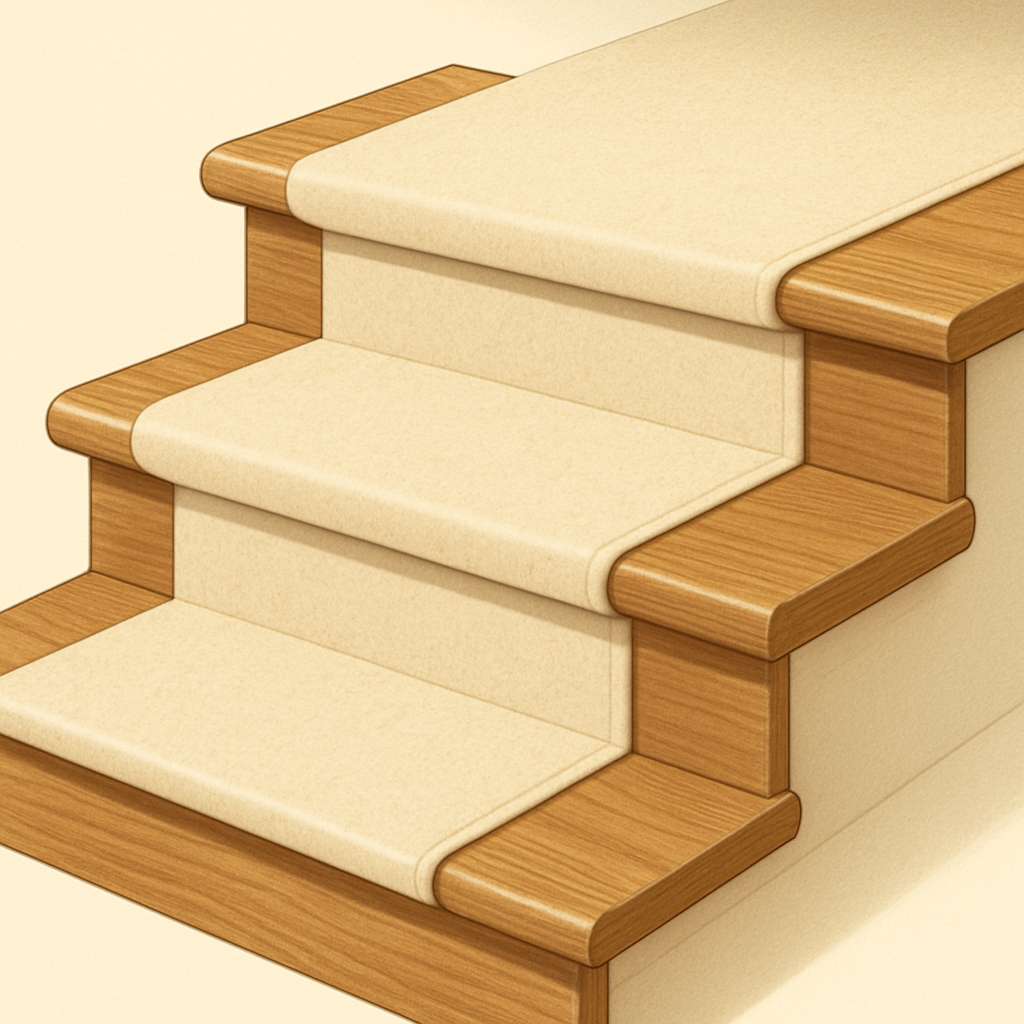
Bare laminate stairs are visually striking but practically slippery in socks and noisier than carpeted stairs. A carpet runner solves both. Materials cost $30 to $80 per stair installed depending on fibre choice; natural-fibre runners (wool, sisal) sit at the upper end, synthetic runners at the lower. The runner is held in place with tackless strip and stair rods or hidden tack at each tread-to-riser corner.
A 13-step staircase with a wool runner adds roughly $400 to $800 to the installed cost (runner plus install) but extends the practical life of the laminate underneath by 10 to 15 years because the high-wear zone (the center third of each tread) is covered. For an owner planning to stay in the house long-term and concerned about stair wear, the runner is good value.
Common Stair Laminate Questions
How much does laminate cost per stair tread?
Installing laminate on a single stair tread plus the matching riser costs $30 to $40 budget, $40 to $55 mid-range, and $55 to $75 premium in 2026. Stair nosing pieces are $3 to $8 per linear foot extra. A 13-step staircase (the most common residential stair count) totals $400 to $975 installed depending on tier.
Why do stairs cost so much more per sqft?
Stairs are the most labour-intensive surface in any laminate install. Each tread requires three precise cuts (left side, right side, front nosing), each riser needs two cuts, and the nosing piece requires careful alignment so the front lip overhangs cleanly. Pros average 20 to 35 minutes per step end-to-end. That works out to $20 to $50 per step in pure labour at standard residential rates.
Should I do my own stair laminate?
No for most DIYers. Stairs are the one room where the cost of a mistake is high (a single bad cut is visible at eye level for years) and the safety stakes are real (loose tread laminate is a fall risk). Pros do stairs in a day; first-time DIYers routinely take three days with mediocre results. The $400 to $975 savings does not justify the risk.
What is stair nosing and why do I need it?
Stair nosing is the rounded or angled piece that caps the front edge of each tread where it meets the riser. It serves three functions: cosmetic (clean visual transition), structural (protects the front edge from chip damage), and code (IRC building code requires a defined nosing dimension between 0.75 and 1.25 inches for residential stairs). Use the matching nosing from your laminate manufacturer, never improvise with quarter round.
Does laminate on stairs meet building code?
Yes when installed correctly with proper stair nosing and a fully-bonded tread. The IRC 311 series specifies minimum tread depth (10 inches), riser height (4 to 7.75 inches), nosing radius, and slip resistance. Most click-lock laminate stair systems sold by Pergo, Shaw, and Mohawk are pre-engineered to meet IRC; off-brand stair kits sometimes do not. Confirm with the manufacturer spec sheet before purchase.
Should I use a carpet runner over laminate stairs?
Optional and increasingly popular. A runner adds slip resistance (laminate stairs can be slippery in socks), sound dampening, and visual warmth. Runners cost $30 to $80 per stair installed for natural fibre options. They also protect the laminate from heavy daily wear, extending stair laminate lifespan by 10+ years.